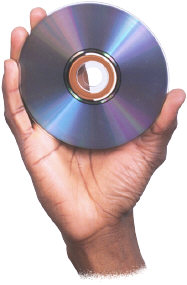
I got my copy of The Disc from a friend at work.
I first heard about The Disc a year before, but I had resisted trying to score a copy. Not so much because I was afraid of being caught (as of yet, there hasn't been any public acknowledgment by the industry about even the existence of The Disc, much less any specific consequences for possessing it), but rather because I had been pretty faithful throughout the years in going through legitimate channels whenever I could.
But I was headed out traveling on a three month long sabbatical and would be unable to access my home library for most of it. And since I can't go even a whole day without some random tune getting stuck in my head, I knew that I would enjoy my time off that much more if I had it. So I handed over $25 for the blank to my friend (most people ask for only the cost of the blanks -- hearkening back to the cassette bootlegging scene of the jam bands of old), and 24 hours later, I had my own copy of The Disc.
It's funny -- you actually need a pretty sophisticated rig to even use it. The index itself is so large that it has to be partitioned to fit in memory. Even the mainstream applications and media players now support the multi-level index-paging and predictive search mechanisms required to use The Disc. And yet the manufacturers never really say explicitly that's why those features exist.
I'll be honest. The Disc is pretty amazing. I legitimately own some 2,000 albums, but you have to understand, that is nothing compared to what is available out there. I had no idea. I mean, I will just go on these musical journeys, picking an artist, listening to one track per album, then jump off to their side project, then over to the drummer's old band, then off to a rare EP that sold only 18 copies back in the day. The Disc has literally changed the way I think about music, the way I feel about it. Having The Disc is like being a kid and staring up into the sky on a cloudless summer night and contemplating the sheer vastness of space, the infinity of star systems, the unknowable size of it all.
As far as I know, no one is certain who made the original. Some say it was a Russian start-up that hoped to profit by selling it. Others say it was a grassroots pirate community working on a distributed network of small machines. Still others say that it was an inside job, with digital copies of the original CD masters lifted en-masse from the labels virtual vaults. In any case, the genie is definitely out of the bottle -- there are too many copies out there and it is far too easy to reproduce. Hell, one copy is too many if you ever wanted to contain it. These are just bits, after all. They are just perfect copies of a perfect copy.
Oh, it's still underground in a nudge-nudge, wink-wink, sort of way. I mean, I'm sure you already know someone who has The Disc. Everyone knows someone who has The Disc. Hell, there is not a single person in the entertainment industry itself that doesn't have a copy -- it's just an indispensable resource. Almost overnight it has become an integral part of the business, of the entertainment world.
If you put a price tag on The Disc by the conventions of the industry then it would be worth almost $100,000,000. (That's one hundred million dollars). And yet I got my copy for $25. Looks like I owe someone some back rent. I guess it's a good thing The Disc doesn't officially exist....
Obviously, that's just a short bit of fiction.
But it raises the question -- is The Disc a technical possibility?
The answer is -- well, yes, of course it is. That actually goes without thinking. So really, the question is when, not if.
(Here I'm going to be conservative in my estimates. I may as well err on the side of predicting this will take longer, as the point is still pretty dramatic.)
So then. When? When can we fit every album ever recorded on to a single portable device? Well, how much music is there, anyway? And how much room would it take up?
According to freedb.org's statistics page, there are 1,654,638 CDs in their database. Now not all of those are full-length albums, but let us pretend they are. If we estimate that each full CD holds about 700MB, and we can compress them with a lossless encoder (like Flac) for about a 50% savings in space, then each CD requires 350MB of storage. (Lossy compression, such as MP3, just makes The Disc available sooner. I'd rather wait and get perfect copies.)
This comes out to only 552 terabytes of storage required to hold all the music currently indexed by FreeDB. Now -- and I'm just making this up -- quadruple that to account for music that doesn't exist currently on CD or has never been submitted to FreeDB. So you need about 2 petabytes of storage on The Disc.
So when is that possible? Blu-ray optical discs are already being made available that support 25GB per disc single-sided, or 50GB double-sided. Since that technology exists today, lets use 50GB per disc in 2005 as the benchmark. (Conservative.)
Here we need to extrapolate a little. Does it have to really be an optical disc? No, not really. The Disc could be a magnetic drive for all we care. However, there has been a consistent trend in the data storage industry for the capacity of read-only random access media to double in storage every 18 months. (Again, conservative.)
Thus we need a growth in our storage capacity by a factor of roughly 40,000. That's just a bit under 2^16. And we're doubling every year and a half...
So given those factors, we will be able to create The Disc in -- under 22 years. 22 years. That's 2027. My kids will own The Disc when they are only teenagers. Hell, I'll still be listening to music in 22 years. I will own The Disc. You will own The Disc.
And by way of reference, they say that the all the texts of the Library Of Congress, if digitized, would require 20 terabytes of storage. By our metrics, this would be available in portable form in about 2017. And to just prove how conservative I was with my estimates, you can build a 20TB storage array with off-the-shelf parts today for $20,000. Sure, it fills a small closet right now, but everything gets smaller and cheaper in this business.
And as a sanity check -- 22 years ago, in 1983, the average big hard drive was 10 megabytes. And today's average big hard drive is 400 GB. A factor of 40,000. Optical growth curves are harder to plot because the standards are revised less frequently. But the pattern is clearly sound.
The Disc is not a possibility. It's an inevitability.
The music industry needs to wake up and learn that their old business model is based entirely on the control of the means of distribution. But they can't control this. No amount of DRM or civil lawsuits or legislative bribery is going to stop this fact once the data, the raw bits, can be passed person to person. It didn't stop people from making copies of cassette tapes or CDs, and it certainly won't stop people from copying The Disc. The difference here is that eventually it will only have to happen once. And it doesn't have to even be physical. It can be passed through fiber networks, via ad-hoc wireless networks, via technologies as-yet uninvented. And then its game over.
Note to the entertainment industry -- if you want to be around in 22 years, change your business model.